An ad getting credit for a purchase does not prove it caused the sale. Comparing similar groups who did and did not see the campaign can help estimate how many extra purchases it produced.
Someone clicks an ad and buys a fictional charger. The campaign report gives the ad credit for the sale. The person might have bought the charger anyway after searching for the model they already needed.
Google’s attribution documentation explains distributing conversion credit among ad interactions. Its lift documentation describes comparing groups shown and not shown the campaign to estimate additional outcomes. One divides credit for sales; the other estimates how many extra sales the campaign brought.
Read the values
| Item | Value |
|---|---|
| Ad group: 10,000 people | 300 purchases |
| Control: 10,000 people | 260 purchases |
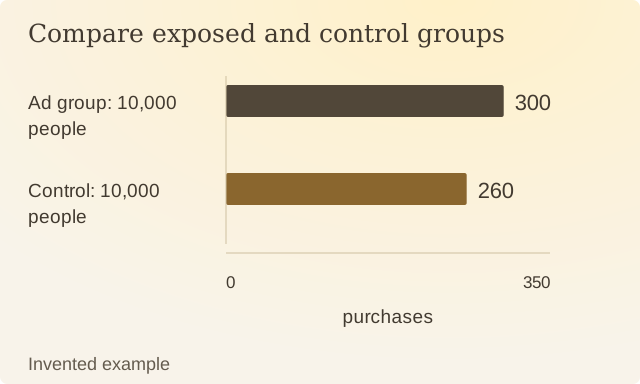
Consider an invented controlled comparison with 10,000 people in each group. The ad group records 300 purchases; the comparison group records 260. That is 40 additional purchases in the observed groups, a difference of 0.4 percentage points. A valid analysis still needs random assignment, uncertainty estimates and the study’s conditions.
A campaign report could attribute far more than 40 orders to ads. That would not make the two reports contradictory: one gives credit for recorded purchases, while the other compares sales with and without the campaign.
Neither analysis directly reports satisfaction, regret or the product’s value to the buyer. Those need their own measures. A sale can be caused by an ad and still be welcome; a sale assigned ad credit may have happened without it.
Sources
Google Ads: About attribution modelsGoogle’s explanation of giving ads credit for recorded purchases and other actions.
Google Ads: About lift studiesGoogle’s guide to comparing results with and without an ad campaign.