Calculate what you pay now and what you can actually redeem later. Check caps, eligibility, expiry and whether the reward returns to a bank account or stays restricted to future spending.
In an invented offer, spending $100 earns 10% cashback capped at $6. The reward is $6 so the effective cost is $94 only if the full reward becomes usable without further required spending. An uncapped reading would wrongly expect $10.
Now change the reward to a $6 voucher usable only on a later $60 order. You still pay $100 today. The voucher can reduce a future order if its conditions fit, but it has not returned $6 to the bank account.
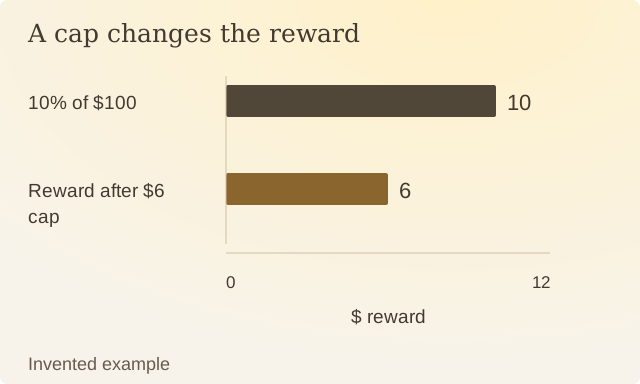
Read the values
| Item | Value |
|---|---|
| 10% of $100 | $10 reward |
| Reward after $6 cap | $6 reward |
The CFPB’s rewards report describes complaints concerning redemption barriers and changing value. These US accounts illustrate questions to ask; they do not show how common such problems are in every reward system.
Check when the reward arrives and whether a returned item reverses it. A promised amount still pending cannot be treated as already received. If the offer requires a particular payment method, compare any associated required cost as well.
Use a lower cost as the comparison only after identifying the usable reward. A voucher can be useful for an order you already want. If you must buy something else to use it, include that extra payment in your comparison.
Sources
CFPB: Credit-card rewards issue spotlightUS complaint-based report, May 2024. Illustrates issues; does not measure their prevalence.