We use attributed accounts to find concrete questions and examine reported experiences. One person’s post cannot tell us how common an experience is or prove that an app helps.
“This happened to me” tells us about one person. It does not tell us how often it happens to others.
In a NoSurf discussion, an author described time shifting between apps after removing one. A shopping-thread author described adding items to qualify for free shipping. Each account identifies a sequence worth examining.
Neither thread supplies a random sample. People choose the forum, decide whether to post and respond to what others already wrote. Upvotes record a response to the post. They do not verify its explanation.
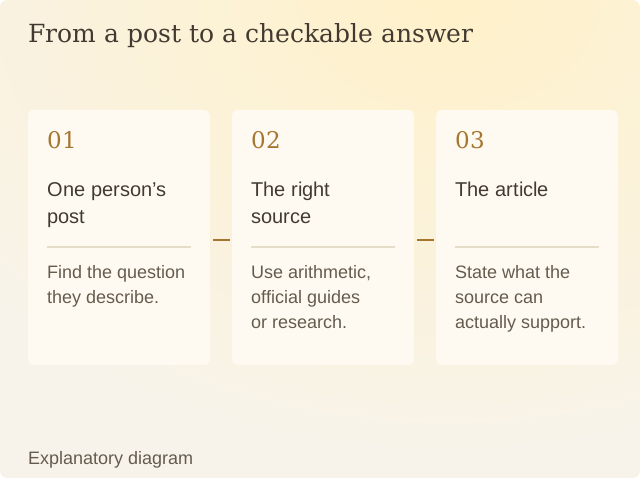
Read the diagram
| Scene | What happens |
|---|---|
| One person’s post | Find the question they describe. |
| The right source | Use arithmetic, official guides or research. |
| The article | State what the source can actually support. |
A discussion about bypassing website limits raises a further design question: what happens when a tool relies on restrictions a person can override? It does not test Renura, which uses a different interaction and permits Continue.
When a thread suggests a mechanism, seek the appropriate source. Payment arithmetic can be checked directly. To check what a platform can do, read its official documentation. A claim about an intervention’s average benefit needs a study with relevant outcomes.
Our notes identify the individual account and keep its limits beside it. We do not reproduce private histories, diagnose authors or treat a support forum as a survey of everyone who uses an app.
Sources
Reddit discussion: Replacing one app with anotherOne person’s account of moving their time from one app to another.
Reddit discussion: Free-shipping thresholdsIndividual self-reports in a support forum. Not a representative sample.
Reddit discussion: Circumventing website limitsIndividual accounts of bypassing limits, not an evaluation of Renura.