Three plans alone do not prove a pricing trick. Compare their prices and features. A decoy is an option that can make another look better by being worse on the things being compared.
In an invented storage offer, A provides 10 GB for $10 a month, B provides 50 GB for $20 and C provides 40 GB for $22. If every other term is equal, B offers more storage for less money than C. That makes C worse on the two stated dimensions.
The 1982 experiment by Huber, Payne and Puto studied how adding an option worse than another on the features being compared can shift choices. Applying the finding to this invented table still does not show what actual customers would choose.
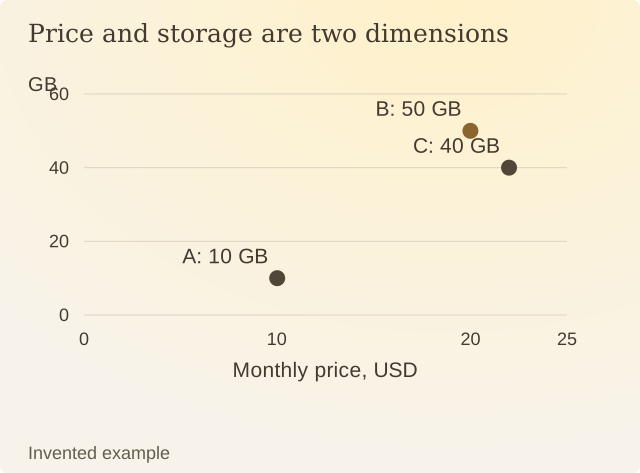
Read the values
| Plan | Monthly price | Storage |
|---|---|---|
| A | $10 | 10 GB |
| B | $20 | 50 GB |
| C | $22 | 40 GB |
Now give C phone support and a different retention policy. The simple comparison breaks because the options differ on more than price and storage. Someone who needs those features may evaluate C differently.
For your task, list the minimum features required before looking at the highlighted plan. Then calculate the payable cost and check billing frequency, limits and cancellation terms. The “popular” label adds no feature to the plan.
In this example, C costs more than B while offering less storage. That is a clear price-and-storage comparison. To say it changed what people chose, we would need a test with actual choices.
Sources
Huber, Payne and Puto: Adding asymmetrically dominated alternativesOriginal choice experiment, 1982. Three options alone do not establish a decoy effect.